Bottneuro publishes it's first publication in NeuroImage
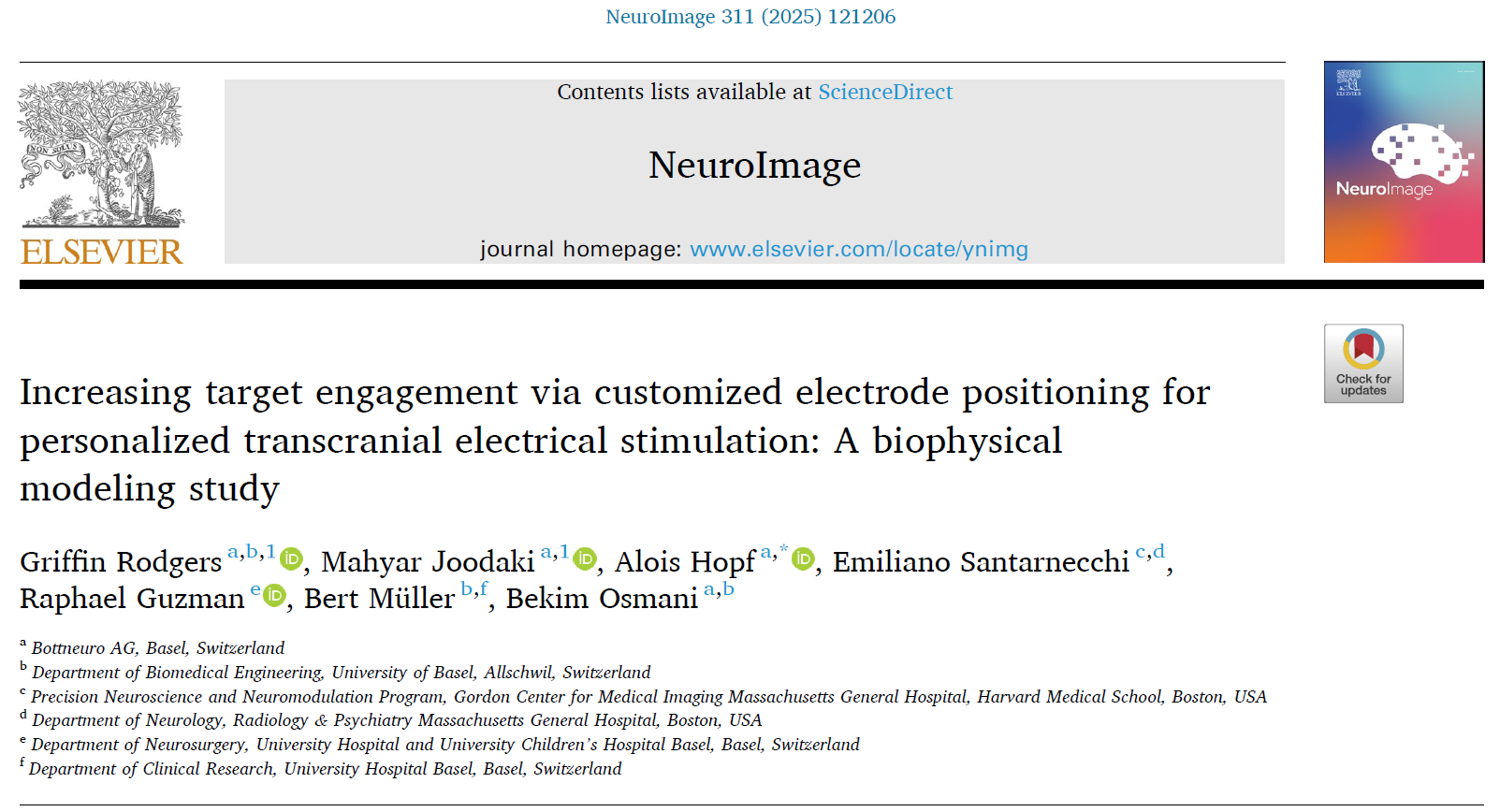
We are thrilled to announce the publication of our first peer-reviewed paper in the prestigious journal NeuroImage. Titled “Increasing target engagement via customized electrode positioning for personalized transcranial electrical stimulation: A biophysical modeling study”, this work marks a significant milestone for our team and contributes to the growing field of personalized neuromodulation.
Key findings include:
- Enhanced Target Engagement: Personalized montages with flexible electrode placement showed superior performance in directing electric fields to the intended brain region.
- Reduced Variability: Optimization based on individual anatomy significantly decreased variability in stimulation intensity across subjects.
- Scalable Precision: Increasing the number of available electrode positions (from 32 to ~86) resulted in greater control and accuracy in stimulation, improving potential therapeutic outcomes.
A New Frontier in Brain Stimulation
Transcranial electrical stimulation (TES) is emerging as a promising non-invasive technique to treat neurological conditions such as Alzheimer’s disease. However, the effectiveness of TES can vary significantly across individuals due to differences in brain anatomy. Traditional TES approaches rely on standardized electrode placements, which often lead to inconsistent stimulation outcomes. This paper addresses this challenge by leveraging individual brain imaging and flexible electrode positioning through digitally designed and 3D-printed TES caps. These caps allow for a greater number of potential electrode sites, enabling more precise targeting of brain regions affected by neurological disorders.
Methodology
We conducted in silico simulations on 10 healthy subjects, focusing on the left angular gyrus - a brain region associated with memory function and relevant to Alzheimer’s therapy. The study compared conventional electrode configurations with custom layouts enabled by flexible positioning.
Implications and Future Directions
This study offers a compelling proof-of-concept for the use of 3D-printed neurostimulator caps in personalized TES. The ability to fine-tune stimulation intensity and focality opens new avenues for treating complex brain networks, such as the default mode network, which is implicated in various cognitive disorders. We are excited about the possibilities this work presents for personalized medicine and neuromodulation therapies. It also highlights the importance of interdisciplinary collaboration, combining neuroscience, engineering, and computational modeling.
📖 Read the full article here: https://doi.org/10.1016/j.neuroimage.2025.121206